
His Excellency, the President of the Republic of Zimbabwe, Dr Emmerson Dambudzo Mnangagwa, was sworn-in as the country’s Head of State and Commander in Chief of the Zimbabwe Defence Forces on 24th November, 2017 after the ruling ZANU-PF Party nominated him as successor on 19 November 2017 following the resignation of his predecessor, Cde Robert Gabriel Mugabe on 21st November, 2017. Dr Mnangagwa is an accomplished lawyer who got admission to the Bar of the High Court of Zambia in 1976 after completing his law studies. Dr Mnangagwa studied for the greater part of his law degree whilst in prison after being arrested for political activism in his quest to see a liberated Zimbabwe. He is also a Farmer of note, who contributes immensely to the growth of Agriculture in Zimbabwe. His passion for economic development has seen him take a lead role in motivating Zimbabweans to open up for business, engage investors and take charge in building Zimbabwe (Nyika Inovakwa neVene Vayo).
Born on 15thSeptember, 1942 in Chief Mapanzure’s area in Zvishavane, President Mnangagwa started his primary education at Lundi Primary School in Mnangagwa Village, Zvishavane, before his family was forced by the colonial regime to relocate to then Northern Rhodesia (Zambia) in 1955. This forced the young Emmerson to complete his secondary education in the then Northern Rhodesia. Thereafter, he enrolled for a four-year City and Guilds Industrial Building course. Midway through his tertiary education, he joined and became active in national liberation politics under the United National Independence Party (UNIP) Youth League of Zambia in 1960. He got expelled from college for his participation in student demonstrations.
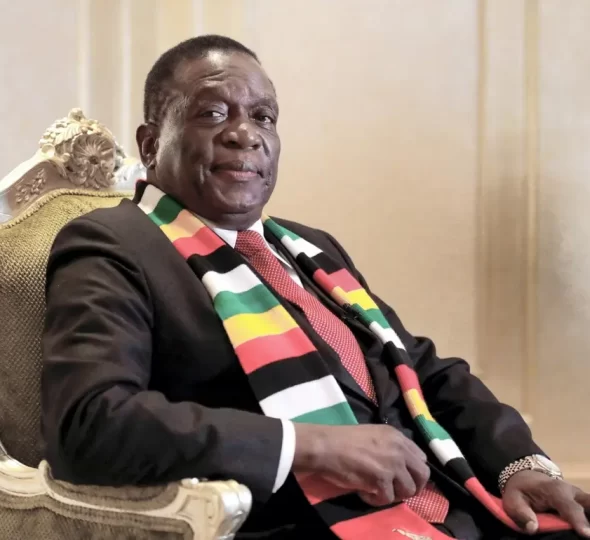
H.E Dr Emmerson Dambudzo Mnangagwa
It is from the UNIP Youth League, that the young Emmerson joined the Zimbabwe African People’s Union (ZAPU) in 1962, which sent him to Tanganyika, now Tanzania en route to Egypt to train as a freedom fighter for the liberation of Zimbabwe from colonial settler rule. He was among the first crop of liberation war cadres to open Bagamoyo, a base camp in Tanzania, which housed cadres from different liberation movements of Southern Africa. In March 1963, Cde Mnangagwa and 12 others were sent to Egypt for military training. But soon after commencing training, back home, ZAPU split, leading to the formation of the Zimbabwe African National Union (ZANU) on 8th August, 1963. Cde Mnangagwa and 12 other cadres decided to join ZANU that same month which led to their brief detention in Egypt at the behest of the ZAPU leadership. They were released into the hands of ZANU following that party’s intervention and were returned to Tanzania. Cde Mnangagwa was one of the five cadres who remained behind in Tanzania for further military training while his other colleagues returned home to Rhodesia. In the same year, President Mnangagwa and his mates were sent to China for further military training, specializing in infantry and engineering, which he completed in May 1964. Upon completion of his military training in China, Cde Mnangagwa returned to Tanganyika before proceeding home to colonial Rhodesia in time for the May 1964 ZANU Congress held in Gweru (Gwelo then) which elected the party’s first executive leadership that included late Reverend Ndabaningi Sithole as President; late Cde Leopold Takawira as Vice President; late Cde Herbert Wiltshire Hamandishe Chitepo as National Chairman; and Cde Robert Gabriel Mugabe as Secretary General, among other appointments.
Trained cadres were infiltrated back into Rhodesia resulting in intensified operations against the settler colonial regime. Cde Mnangagwa was deployed in the Fort Victoria area as part of a group code-named “Crocodile Group”, to hit select targets and to intensify recruitment of cadres from areas such as Harare, Fort Victoria, Belingwe and Macheke who were sent to Tanzania via Malawi for military training. Together with a colleague, the late Mathew Malowa, Cde Mnangagwa blew-up a locomotive in Fort Victoria (Masvingo), an act for which he was arrested in 1965 and sentenced to death after a sham trial. He escaped execution by a whisker when it was established that he was underage. His death sentence was commuted to ten years’ imprisonment which he served at Harare, Greys and Khami Maximum prisons. Like many other liberation war veterans in similar situations, he was ruthlessly tortured both before and during imprisonment. To this day, he suffers a hearing impairment from a damaged ear.
Cde Mnangagwa was released in 1973 and subsequently deported to Zambia by the Rhodesians. In Zambia, he completed his Law studies at the University of Zambia and was admitted to the Bar of the High Court of Zambia in 1976. Among the high profile cases that he defended that time included the late Commander of the Zimbabwe National Liberation Army (ZANLA), Cde Josiah Magama Tongogara, following his arrest by the Zambian government on allegation that Cde Tongogara and other ZANLA cadres had a hand in the assassination of the late Chairman of ZANU, Cde Herbert Chitepo. The late General and his co-assassins were acquitted. Cde Mnangagwa left Zambia for Mozambique in 1977 to prosecute the liberation struggle with other comrades already there. He was appointed Special Assistant to the party President Cde R.G. Mugabe. At the 1977 Chimoio Congress, he was elected member of the National Executive of ZANU. In that capacity he also served as Head of both military and civil intelligence, was a member of the ZANLA High Command, and was member of the Party’s Central Committee. Following the Ceasefire Agreement at Lancaster House Conference in 1980, Cde Mnangagwa led the first group of comrades comprising Didymus Mutasa, the late Edison Zvobgo and late General Rex (Mujuru) Nhongo from Maputo to Harare, (then Salisbury) to prepare for the watershed 1980 Elections that ended settler colonialism in Zimbabwe and transferred power to the black majority.
At Independence from 1980, President E.D. Mnangagwa was appointed to various ministerial portfolios as well as to the post of Speaker of Parliament from 2000 to 2005. His first ministerial responsibility after the 1980 elections was that of Minister of National Security and Head of the Joint Military High Command, appointments which saw him oversee the integration of erstwhile warring forces into the Zimbabwe National Army (ZNA). After the 1987 Unity Accord between ZANU PF and PF ZAPU, he became the Minister of Justice, Legal and Parliamentary Affairs, as well as the Leader of the House in 1988, a portfolio he held up to the year 2000 when he was elected as the Speaker of Parliament, a post he held for a period of five years. He was Acting Minister of Finance from 1995 to 1996 before also acting as Minister of Foreign Affairs for a short period. During the period 2005 to 2009, he was the Minister of Rural Housing and Social Amenities. Cde Mnangagwa became the Minister of Defence from 2009 to 2013. After the 2013 harmonised elections, he was again appointed Minister of Justice, Legal and Parliamentary Affairs. In December 2014, he was elevated to the post of Vice President of the Republic of Zimbabwe, while continuing to be responsible for the administration of the Ministry of Justice, Legal and Parliamentary Affairs. As Vice President, he was also responsible for the supervision of Economic Ministries. On 19th November, 2017, the ZANU-PF Central Committee nominated him President of the Republic following the resignation of his predecessor, Cde Robert Mugabe.
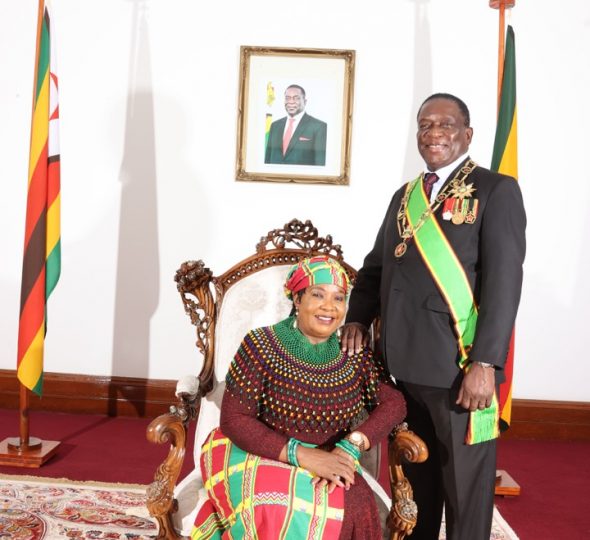
H.E Dr Emmerson Dambudzo Mnangagwa and First Lady Amai Auxillia Mnangagwa
At his inauguration as State President on 24th November 2017, President Mnangagwa committed himself and his new administration to prioritising national economic recovery, elimination of corruption, re-engaging western countries and engaging the rest of the world to restore and strengthen both economic and diplomatic relations. Above all, he committed himself to ensuring a free, fair, transparent and credible 2018 plebiscite for Zimbabweans a promise he fulfilled on July 30, 2018. He stepped up the re-engagement process with western capitals to convey his vision for Zimbabwe in the new political dispensation. At the same time, he reaffirmed Zimbabwe’s membership to SADC, COMESA, the African Union, and has made clear overtures to rejoin the Commonwealth. Alongside this broad thrust, President Mnangagwa has deepened Zimbabwe’s relations with her traditional allies across the globe, all for mutually gainful partnerships.
Through the mantra “Zimbabwe is Open for Business”, President Mnangagwa set the vision to transform Zimbabwe into a middle income economy by the year 2030. To attain that vision through rapid national economic recovery and sustainable socio-economic development, he immediately instituted critical economic policy reforms upon taking the office of President. He revised the constraining Indigenisation and Economic Empowerment Act in order to open up all sectors to unlimited foreign investment, except in two strategic national mineral sub-sectors: diamonds and platinum. He finalised the establishment of special economic zones; stepped up the rebuilding of critical national infrastructure such as roads, rail, energy, irrigation, while stepping up dam construction for food security through enhanced agriculture. President Mnangagwa secured the renewal of financing arrangements for stalled critical national projects under bilateral arrangements with key partner nations such as the People’s Republic of China, Russia, Brazil, India and others.
His administration has expanded “Command Agriculture”, a national food security programme he successfully spearheaded during his tenure as Vice President under the country’s much-acclaimed Zimbabwe Agenda for Socio-Economic Transformation (Zim-Asset) national blueprint programme. Anchored on simple projections and the realisation of the Public – Private Partnership model in delivering national development programmes, Command Agriculture yielded a bumper harvest for Zimbabwe in the 2016/2017cropping season, initialising a permanent turnaround towards national food self-sufficiency. Its replication in other agricultural crops and the livestock sector has made Zimbabwe food secure. Increased direct foreign investment inflows following reforms to open up the economy, has triggered economic recovery with industry hovering above 50% capacity utilization.
President Mnangagwa’s new policy thrust under the mantra, “Zimbabwe is Open for Business”, underpinned by a sincere reengagement of western capitals including international financial institutions, as well as the renewal and intensification of economic ties with traditional foreign cooperating partners has inspired a lot of confidence and goodwill towards Zimbabwe. Today, Zimbabwe boasts US$20 billion in Foreign Direct Investment (FDI) commitments, up from a lowly average of US$500m a year. His Government has since revised the country’s economic growth projections for 2018 from 4.5% to upwards of 5%, with the more conservative Bretton Woods Institutions, the International Monetary Fund (IMF) and the World Bank (WB) increasing their own growth projections for the current year from 1.8% to 2.7%. The historically sluggish economy is showing strong signs of recovery on the back of a structural shift towards productive imports as opposed to consumptive ones which dominated previous years.
On the political front, President Emmerson Mnangagwa has delivered on his promise for an open political society where freedoms are respected and where elections are free, fair and transparent, and held under international supervision. Indeed the 2018 elections were largely peaceful, marking a major break with Zimbabwe’s violent electoral past. Notwithstanding spirited attempts on his life during the election campaign period, he has remained steadfast in brokering unity, peace and tolerance to divergent views. On 30th July, 2018, Zimbabwe held its harmonised elections where President Mnangagwa romped to victory having garnered 50.8 % of the presidential votes, while his party clinched 145 seats, to secure a two-thirds majority in Parliament. He was inaugurated as the President of the Republic of Zimbabwe and Commander-In-Chief of the Zimbabwe Defence Forces on 26 August, 2018.
Your feedback has been received.
